

In today's visually-driven market, showcasing a commercial construction project requires more than just schematics and timelines. High-impact commercial construction pictures are the cornerstone of successful marketing, stakeholder communication, and project documentation. These images don't just show progress; they tell a story of transformation, precision, and value, ultimately attracting investors, securing tenants, and building a powerful brand portfolio for architects, builders, and real estate professionals.
From sweeping aerial drone shots that capture the full scale of a Florida development to meticulously detailed interior photos that highlight craftsmanship, the right photography is an indispensable asset. It translates complex work into a compelling, easily understood visual narrative. This guide moves beyond simple snapshots and explores 8 critical types of commercial construction pictures, providing a deep dive into the strategy behind each one. We will break down the technical details, offer actionable tips for capturing them, and reveal how leveraging these visuals can significantly accelerate your project's success.
Discover how to transform your construction site from a work-in-progress into a compelling visual narrative that drives tangible business results. For professionals needing to document or market a project swiftly, we offer a streamlined solution. Our team provides next-day appointments and is available 7 days a week, ensuring you get the critical images and results you need without delay. We back this with responsive customer service via phone, text, email, and chat, seven days a week, to keep your project moving forward. Let's explore the images that build value.
1. Progress Shot
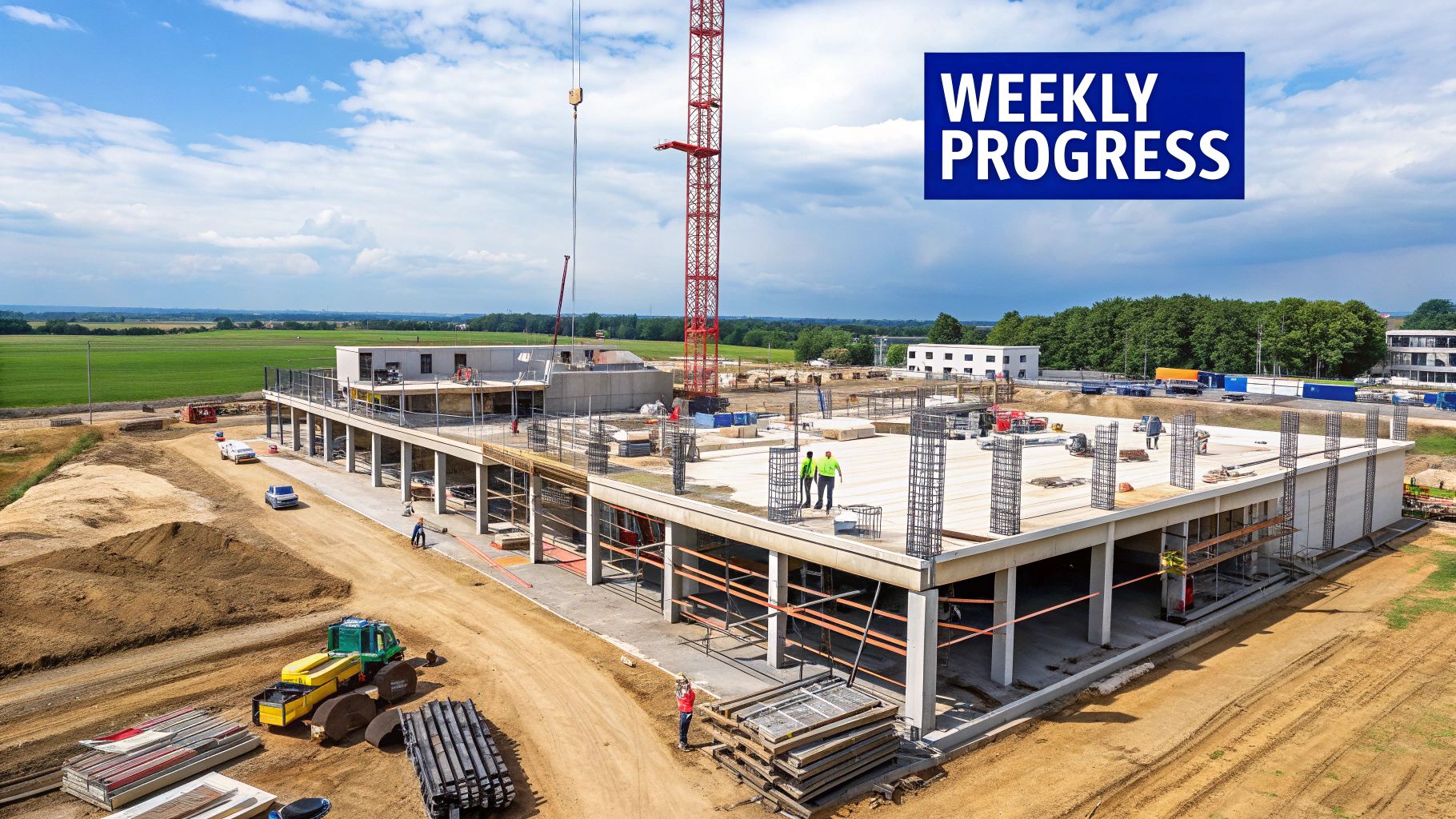
Progress shots are a visual record of a commercial project's evolution, captured at regular intervals to document milestones and track development. These images are far more than simple snapshots; they are critical data points for project managers, investors, and clients, offering a transparent, chronological account of the construction journey from the initial groundbreaking to the final touches. This visual timeline is essential for quality control, stakeholder communication, and dispute resolution.
Strategic Importance and Application
The primary function of progress shots is to provide undeniable evidence of work completed. For firms like Turner Construction and Skanska USA, these photos are integrated into management platforms such as Procore to verify contractor invoices, monitor safety compliance, and keep remote stakeholders informed. They serve as a powerful tool for accountability and are often a contractual requirement.
Key Strategy: Treat progress photos as a core component of your project management workflow, not just an archival task. Integrate them directly into reporting and payment verification systems to enhance operational efficiency.
Actionable Tips for Professional Progress Shots
To maximize the value of your commercial construction pictures, consistency is crucial. Implement these professional tactics:
- Establish Fixed Vantage Points: Identify several key locations on-site (and off-site for aerial views) and mark them. All progress shots should be taken from these exact spots to create a consistent, time-lapse effect.
- Schedule for Consistent Lighting: Shoot at the same time of day for each session. This minimizes variations in shadows and lighting, making it easier to compare progress accurately between photos.
- Implement a Naming Convention: A standardized file naming system (e.g.,
ProjectCode_Date_Viewpoint.jpg) is non-negotiable for easy sorting and retrieval.
Documenting a project requires reliability and speed. That's why we offer 7-day a week availability and next-day appointments, ensuring you never miss a critical milestone and get your results fast. Contact our 7-day a week customer service team via phone, text, email, or chat to schedule your shoot. These progress shots are a key element in planning a successful construction project.
2. Aerial/Drone Photography
Aerial drone photography captures commercial construction sites from elevated perspectives using unmanned aerial vehicles (UAVs). These photographs provide bird's-eye views of entire project sites, showing spatial relationships, site logistics, and overall progress impossible to capture from ground level. This technology has revolutionized the creation of commercial construction pictures, offering comprehensive site overviews for project management and sophisticated imagery for marketing campaigns.
Strategic Importance and Application
The primary value of aerial photography is its ability to provide macro-level context. For large-scale projects like Amazon's HQ2 construction or infrastructure work monitored by firms like Bechtel, drones offer an unparalleled perspective on site access, material staging, and overall environmental impact. This data is invaluable for logistical planning, stakeholder presentations, and creating high-impact marketing materials that showcase the project's scale and location.
Key Strategy: Leverage aerial imagery beyond simple progress updates. Use orthomosaic maps and 3D models generated from drone data for precise site measurements, earthwork volume calculations, and safety planning.
Actionable Tips for Professional Aerial/Drone Shots
To capture effective and compliant aerial images, a professional approach is essential. Adhere to these critical practices:
- Standardize Flight Paths: Create and save automated flight paths for key overviews. Replicating the exact altitude, angle, and path ensures shot-to-shot consistency for accurate time-lapse sequences and progress reporting.
- Optimize for Lighting: Schedule flights for early morning or late afternoon, known as the "golden hours." The soft, directional light during these times minimizes harsh shadows and enhances the texture and definition of the site and structures.
- Prioritize Safety and Compliance: Always operate under FAA Part 107 regulations. Check NOTAMs (Notices to Airmen) before every flight, maintain detailed flight logs, and establish clear exclusion zones around active machinery and personnel.
Capturing the right aerial view at the right time is critical. With our 7-day-a-week availability, next-day appointments, and prompt delivery of results, you can document key phases without delay. Contact our 7-day a week customer service team by phone, text, email, or chat to schedule your flight. These aerial views are a powerful component of professional drone photography for construction.
3. Interior Finish Photography
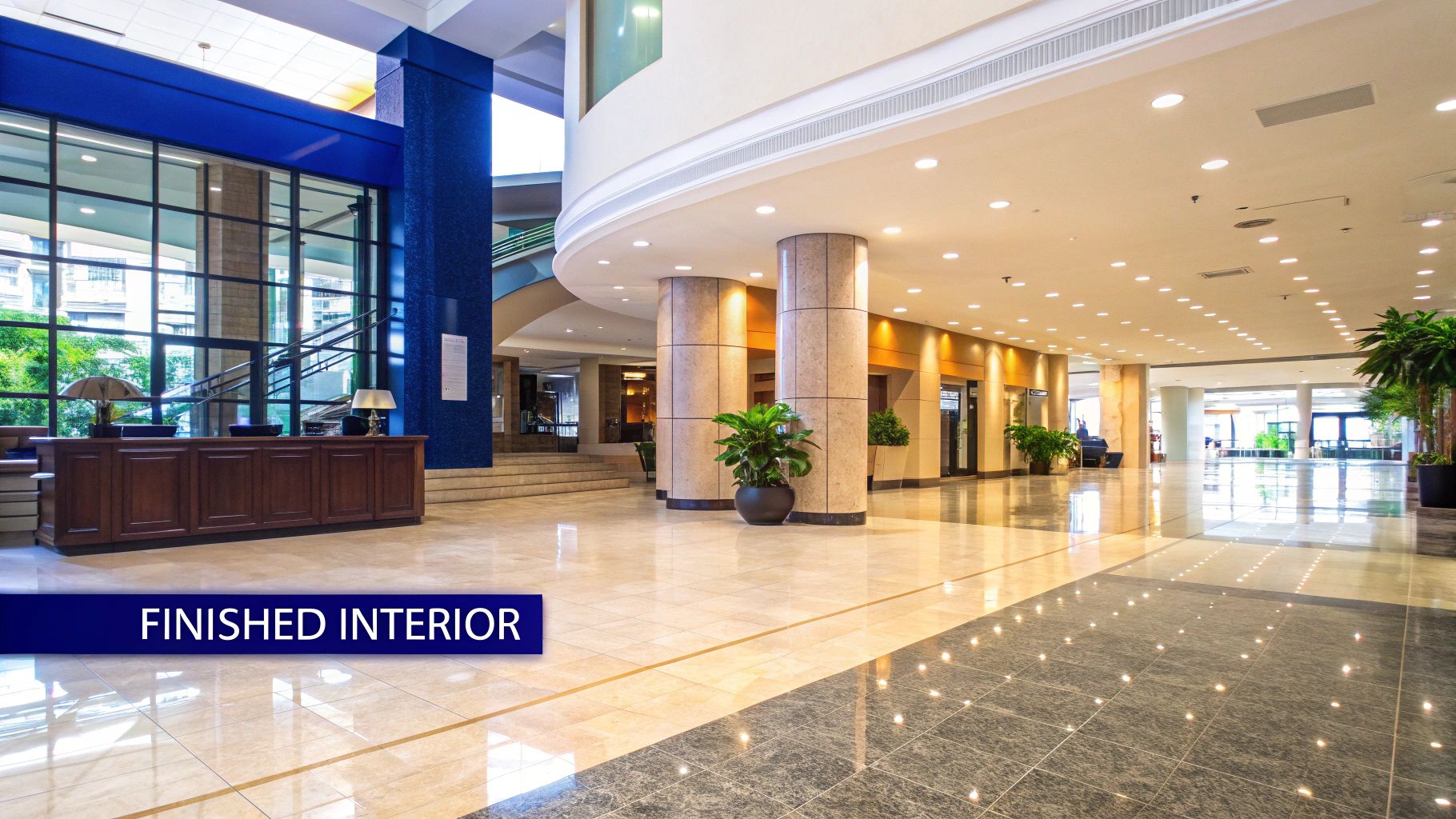
Interior finish photography showcases the completed interior spaces of commercial buildings, highlighting the culmination of design, material selection, and craftsmanship. These images are captured during the final stages of construction or just before occupancy, focusing on architectural details, high-end finishes, and the overall aesthetic quality. They serve a crucial dual purpose as both a final record for the construction team and as powerful marketing collateral for architects, developers, and future tenants.
Strategic Importance and Application
The primary function of interior finish photography is to translate the architectural vision and build quality into a compelling visual narrative. For iconic projects like Apple Park or Hudson Yards NYC, these photos are essential for publication in outlets like Architectural Digest, solidifying the project's prestige. For developers, these images populate leasing brochures and websites, attracting high-value commercial tenants by demonstrating the quality and functionality of the space.
Key Strategy: Schedule photography after the final clean but before tenant move-in to capture the space in its purest, most pristine state. This "blank canvas" allows potential occupants to envision their own operations within the environment.
Actionable Tips for Professional Interior Finish Shots
To produce high-impact commercial construction pictures of interiors, precision and technical skill are paramount. Implement these professional tactics:
- Master Lighting and Composition: Capture both wide-angle shots to convey the scale of a space and detailed close-ups of premium materials and fixtures. Shoot during optimal natural light hours (typically 10am-3pm) and use a tripod for crisp, blur-free images.
- Ensure Color Accuracy: Use a neutral white balance and professional color grading in post-production. This guarantees that paint colors, flooring, and other finishes are represented accurately, which is critical for marketing materials.
- Utilize High-Resolution Equipment: A high-resolution camera (20+ megapixels) is non-negotiable for producing print-quality images suitable for large-format advertisements and architectural portfolios. The right equipment is a key part of the process, and you can learn more about the best lenses for interior photography.
Capturing the perfect interior shot requires flexibility. With our 7-day a week availability and next-day appointments, we can schedule your shoot to align perfectly with your project's completion timeline. Contact our dedicated customer service team any day via phone, text, email, or chat to book a session that showcases your finished work in the best possible light.
4. Exterior Facade Photography
Exterior facade photographs are the definitive architectural portraits of a commercial building, capturing its external appearance, design intent, and material quality. These images document the building envelope, structural elements, finishes, and overall aesthetic from carefully chosen angles and lighting conditions. More than just pretty pictures, they are vital for architectural portfolios, marketing campaigns, and documenting the final condition of the exterior for asset management and future reference.
Strategic Importance and Application
Facade photography serves as the primary visual asset for marketing a completed commercial property. For architects like Foster + Partners documenting projects such as the Gherkin Building, these images are crucial for award submissions and firm portfolios. For developers, high-quality exterior shots are the cornerstone of leasing brochures, websites, and press releases, directly influencing public perception and attracting high-value tenants. These commercial construction pictures validate the design's execution and showcase the craftsmanship involved.
Key Strategy: Plan facade photography as a distinct project phase post-completion, but before landscaping fully matures or occupancy begins. This ensures a clean, unobstructed view that highlights the pure architectural form.
Actionable Tips for Professional Facade Photography
To create compelling facade images that do justice to the architectural vision, precision and planning are essential. Implement these professional tactics:
- Vary Timing for Lighting: Shoot the same elevations during different times of day, especially the "golden hours" at sunrise and sunset. This reveals how light and shadow interact with the building's form and materials, adding depth and drama.
- Use Specialized Equipment: A polarizing filter is non-negotiable for managing reflections on glass and enhancing the color saturation of materials. Telephoto lenses help compress perspective and isolate specific architectural details without distortion.
- Incorporate Scale: Include human elements, such as people walking near the entrance, to provide an immediate and relatable sense of the building's scale and how it interacts with its environment.
Capturing the perfect light on a facade is time-sensitive. That's why we offer 7-day a week availability and next-day appointments, ensuring you can schedule a shoot precisely when the conditions are ideal. Contact our customer service team, available 7 days a week via phone, text, email, and chat, to book your session and get your results fast. Understanding the materials used is key to great shots; you can explore the details of common home exterior finishings to better inform your photography brief.
5. Safety/Compliance Photography
Safety and compliance photographs are a crucial form of visual documentation, captured specifically to verify adherence to strict industry regulations, building codes, and safety protocols. These are not general site photos; they are meticulous records proving that all construction activities align with OSHA standards and local ordinances. This type of photography acts as a powerful risk management tool, providing proactive evidence of a safe work environment and reactive documentation for incident investigations or insurance claims.
Strategic Importance and Application
The primary function of safety photography is to create an objective, time-stamped record of site conditions. For leading firms like Kiewit and Bechtel, this visual evidence is integral to their safety programs, used for training, daily briefings, and audits. These commercial construction pictures are essential for demonstrating due diligence to insurance carriers and regulatory bodies, potentially reducing liability and lowering premiums. They provide undeniable proof that safety measures were in place at a specific time.
Key Strategy: Integrate safety photography into your daily site management routine. Designate a trained individual to document high-risk activities, PPE usage, and equipment status, making these images part of the official daily log.
Actionable Tips for Professional Safety/Compliance Shots
To ensure your safety photos are effective for legal and administrative purposes, precision and detail are paramount. Implement these professional tactics:
- Focus on High-Risk Areas: Prioritize documenting activities with higher potential for incidents, such as excavation, crane operations, and work at heights. Capture details like safety harnesses, guardrails, and proper trench shoring.
- Document Both Good and Bad: Photographing compliant conditions establishes a baseline of your safety standards. When non-compliant situations are found, document them immediately, followed by a photo of the corrective action taken.
- Maintain Detailed Metadata: Ensure every image file includes the date, time, precise location on site, and a brief description of the activity. This data is critical for the photo to be considered valid evidence.
Crucial for demonstrating adherence to regulations and maintaining a safe environment, professional photography is an integral part of overall security in construction. With our 7-day a week availability and next-day appointments, we can dispatch a photographer to document critical safety milestones or incidents on short notice. Contact our 7-day a week customer service team via phone, text, email, or chat to schedule and get your results promptly.
6. Before-and-After Photography
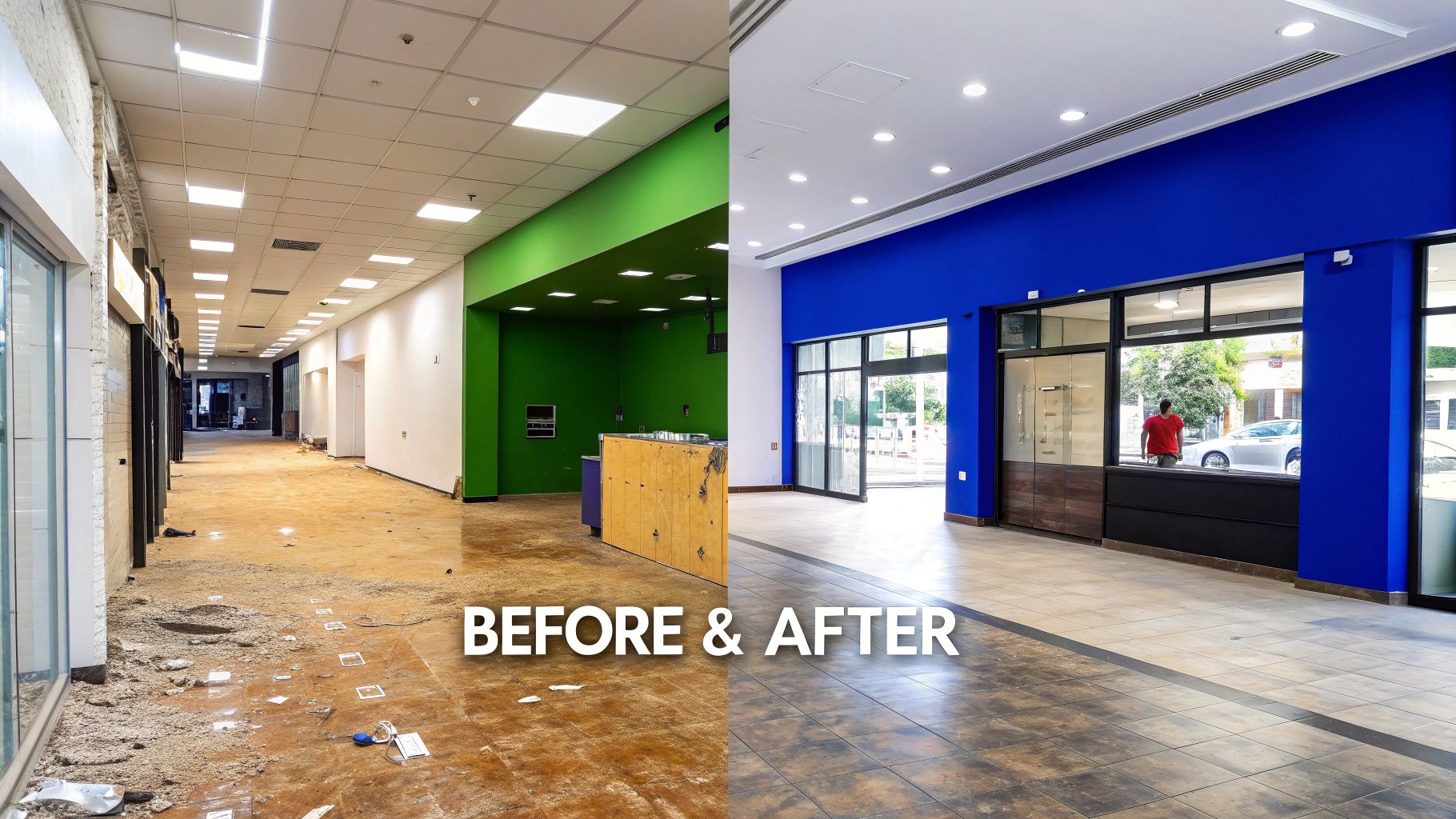
Before-and-after photography pairs images of a space in its original condition with photos taken after renovation or construction is complete. This powerful comparative technique dramatically illustrates the transformation, providing a clear and compelling visual narrative of the value added. For commercial construction, these shots are a cornerstone of marketing, effectively showcasing a firm's capability to clients, investors, and stakeholders by highlighting the quality and impact of their work.
Strategic Importance and Application
The core function of before-and-after photography is to tell a story of transformation and competence. This method is heavily used by design-build firms and renovation specialists to populate portfolios and case studies, proving their project execution skills. For instance, home renovation networks like HGTV have built entire brands around this concept, demonstrating its undeniable marketing power to a mass audience. In a commercial context, these images justify investment and build trust with prospective clients by offering tangible proof of expertise.
Key Strategy: Frame before-and-after sets as mini case studies. Use them in marketing proposals, on your website, and in social media campaigns to provide undeniable evidence of your ability to execute a client's vision and enhance property value.
Actionable Tips for Professional Before-and-After Shots
To create a striking comparison, precision is paramount. The goal is to isolate the construction work as the only variable between the two shots.
- Lock Down Your Position: Use a tripod and mark its exact location on the floor before any demolition begins. This ensures the "after" shot is perfectly aligned for a seamless comparison.
- Replicate Camera Settings: Meticulously record and reuse the exact same focal length, aperture, height, and angle for both shoots. This technical consistency is non-negotiable for a professional result.
- Match the Lighting: Photograph both the "before" and "after" scenes at the same time of day and under similar weather conditions to maintain consistent natural light and shadows.
Capturing the perfect "before" shot is a critical first step. With our next-day appointments and 7-day a week availability, you can schedule a photographer to document the space before demolition begins. Reach out to our dedicated customer service team, available 7 days a week via phone, text, email, and chat, to secure your booking. These powerful commercial construction pictures are essential for building a compelling portfolio.
7. Time-Lapse Frame
Time-lapse frames are individual images extracted from a sequence captured at regular intervals over an extended period, often months or years. These frames are the building blocks of a time-lapse video, which compresses the entire construction lifecycle into a compelling, short-form narrative. They offer a dynamic and powerful way to visualize project scale, complexity, and momentum, serving as both a granular documentation tool and a high-impact marketing asset.
Strategic Importance and Application
The primary value of time-lapse photography is its ability to condense time and tell a story that resonates with investors, stakeholders, and the public. Major developments like Hudson Yards in NYC and Apple Park utilized extensive time-lapses to generate buzz and showcase their monumental achievements. These commercial construction pictures are not just for marketing; they are invaluable for logistics planning, site security monitoring, and creating an indisputable visual record of the project from start to finish.
Key Strategy: Leverage time-lapse frames as multi-purpose assets. Use the final video for marketing campaigns and public relations, while using individual frames for detailed progress reports, dispute resolution, and investor updates.
Actionable Tips for Professional Time-Lapse Frames
Creating a seamless and professional time-lapse requires meticulous planning and robust equipment. Ensure your visual story is captured without interruption:
- Secure a Weatherproof Location: Mount cameras in a secure, elevated, and weatherproof enclosure with an unobstructed view of the site. This is critical for long-term projects exposed to the elements.
- Ensure Continuous Power and Data: Use redundant power sources like solar panels with battery backups. Implement a system for automatic cloud backup of high-capacity memory cards to prevent data loss.
- Automate and Standardize Capture: Set an intervalometer to capture frames every 15-30 minutes during daylight hours. Lock in camera settings (aperture, ISO, shutter speed) to maintain visual consistency across thousands of images.
Long-term projects demand consistent service. We provide 7-day a week availability and next-day appointments to install, check, and maintain your time-lapse equipment, ensuring no phase of your project goes undocumented. Contact our customer service team any day via phone, text, email, or chat for reliable support and fast results. These time-lapse frames are a powerful part of a comprehensive real estate marketing strategy.
8. As-Built/Documentation Photography
As-built documentation photographs meticulously record the actual, completed condition of a commercial project exactly as it was built. These images serve as a permanent visual record, documenting the final state of structural elements, MEP (mechanical, electrical, plumbing) systems, and finishes. Unlike progress shots that track evolution, as-built photography captures the final, unchangeable conditions with precise detail, serving critical legal, warranty, maintenance, and future renovation purposes.
Strategic Importance and Application
The core value of as-built photography lies in creating an immutable source of truth for a building's infrastructure. For complex facilities like data centers or hospitals, these images are indispensable for facility management teams, providing visual references for system routing, access points, and equipment specifications long after walls are closed. They are crucial for verifying that work matches the design specifications and are often integrated with BIM (Building Information Modeling) data. For large-scale projects like commercial rollouts, effective as-built modelling at scale is vital, with photography serving as a critical component of the documentation workflow.
Key Strategy: Treat as-built photography as a final asset handover deliverable. Integrate these detailed images into your operations and maintenance (O&M) manuals and digital twin models to create a comprehensive, long-term facility management resource.
Actionable Tips for Professional As-Built Shots
To create a functional and reliable visual database, your commercial construction pictures must be systematic and detailed. Implement these professional tactics:
- Photograph Before Enclosure: The most critical step is to capture comprehensive images of all systems (electrical, plumbing, HVAC, data) after inspection but before drywall or ceilings are installed.
- Include Scale and Context: Place a ruler or other scale reference in photos of specific components. Take wide, medium, and close-up shots of each area to provide both overview context and granular detail.
- Systematic Labeling: Use a rigorous file naming convention that includes the building area, system type, and date (e.g.,
ProjectX_Floor2_Elec-Panel-A_2023-10-26.jpg). This makes the archive searchable and useful.
Creating this permanent record is a time-sensitive task. We offer 7-day a week availability and next-day appointments to ensure we can document critical systems before they are concealed. Contact our customer service team, available seven days a week via phone, text, email, and chat, to schedule this essential service and get your results quickly. For an even more immersive record, consider pairing these photos with a detailed 3D tour, which you can learn more about creating for your project.
Commercial Construction Photo Types — 8-Point Comparison
| Method | 🔄 Implementation Complexity | ⚡ Resource Requirements | ⭐📊 Expected Outcomes / Impact | Ideal Use Cases | 💡 Key Advantages |
|---|---|---|---|---|---|
| Progress Shot | Medium — recurring schedule, consistent framing | Low–Medium — DSLR/phone, dedicated personnel, cloud storage | ⭐⭐⭐ — reliable progress visibility; 📊 good for schedule tracking & QC | Project monitoring, stakeholder reporting, quality assurance | Standardized record of progress; supports dispute resolution and remote updates |
| Aerial / Drone Photography | High — flight planning, regulatory compliance, certified operators | High — drones (RTK), Part 107, skilled pilots, data processing/storage | ⭐⭐⭐⭐ — excellent site overview; 📊 enables 3D models, volumetrics, mapping | Site surveys, large-site progress monitoring, marketing, hard-to-reach inspections | Comprehensive bird’s-eye perspective; safer access to elevated areas; rapid coverage |
| Interior Finish Photography | Medium — staging, lighting control, composition expertise | High — professional photographer, lighting kits, post-processing time | ⭐⭐⭐⭐ — high marketing impact; 📊 showcases finishes and design intent | Marketing collateral, leasing listings, architectural portfolios, award submissions | Highlights craftsmanship and material quality; attracts tenants/investors |
| Exterior Facade Photography | Medium–High — time-of-day planning, access coordination | Medium–High — wide/tele lenses, lifts or drones, filters, possible permits | ⭐⭐⭐ — validates design execution; 📊 useful for marketing and maintenance records | Facade validation, promotional imagery, maintenance documentation | Documents exterior condition and materials; supports asset valuation |
| Safety / Compliance Photography | Medium — protocol-driven, consistent metadata capture | Medium — trained personnel, secure storage, possible body cams | ⭐⭐⭐ — critical for audits and claims; 📊 reduces regulatory and liability risk | Regulatory compliance, safety audits, incident investigations, training | Demonstrates compliance, provides incident evidence, promotes safety culture |
| Before‑and‑After Photography | Medium — requires preplanning and exact camera replication | Low–Medium — tripod, marked positions, consistent settings, staging | ⭐⭐⭐⭐ — very effective marketing; 📊 powerful transformation storytelling | Renovation marketing, portfolios, social media, case studies | Dramatic visual proof of value and ROI; highly engaging for audiences |
| Time‑Lapse Frame | High — long-term, secure setup; power and data continuity | Medium–High — interval cameras, power/backups, large storage, editing | ⭐⭐⭐⭐ — highly engaging visual content; 📊 compresses project timeline effectively | Marketing videos, investor updates, website features, portfolio showcases | Automated, shareable documentation that illustrates project scale and pace |
| As‑Built / Documentation Photography | High — exhaustive, systematic coverage, standards adherence | High — trained staff, high‑res gear, indexing systems, long-term storage | ⭐⭐⭐ — essential legal/maintenance record; 📊 enables accurate facility management | Facility maintenance, warranty documentation, future renovations, BIM updates | Permanent precise record for maintenance, troubleshooting, and regulatory proof |
Capture Your Project's Full Value with Professional Photography, Available 7 Days a Week
Throughout this guide, we've explored the immense strategic value locked within high-quality commercial construction pictures. From the granular detail of progress shots to the breathtaking scope of aerial photography, each image type serves a critical, multifaceted role. These visuals are not mere decorations; they are powerful assets for marketing, essential tools for project management, and invaluable records for documentation and compliance.
The central lesson is that intentional, professionally captured imagery drives tangible results. It accelerates leasing, secures investors, streamlines stakeholder communication, and protects your firm from potential disputes. By understanding the unique purpose of each photographic style-from interior finishes to before-and-after transformations-you gain a significant competitive advantage. You are equipped to tell a compelling, comprehensive story of your project's journey from groundbreaking to grand opening.
The Critical Role of Strategic Visual Documentation
Mastering the art and science of commercial construction pictures is no longer a luxury, it's a fundamental necessity for any developer, builder, or real estate professional in today's competitive market. The eight distinct photography types we've analyzed serve critical purposes:
- Progress & Time-Lapse Shots: Provide indisputable evidence of project milestones for investors and stakeholders.
- Aerial & Drone Photography: Offer unparalleled marketing appeal and crucial site-planning context.
- Interior & Exterior Photos: Showcase the quality of craftsmanship and attract potential tenants or buyers long before completion.
- Safety, Compliance, & As-Built Images: Form a vital visual log for risk mitigation, regulatory adherence, and future maintenance.
The key takeaway is clear: strategic imagery adds measurable value at every stage of a project's lifecycle. It transforms abstract plans and raw materials into a tangible, desirable asset.
Bridging Vision with On-the-Ground Reality
However, understanding the why is only half the battle. Executing this level of photography requires technical expertise, specialized equipment, and, most critically, availability that aligns with the unpredictable, fast-paced nature of a construction site. A critical pour, a facade installation, or a safety inspection doesn't wait for a convenient weekday schedule. Delays in documentation can lead to delays in payment, approvals, and marketing launches.
This is where our operational model is designed to support you. We recognize that construction projects operate on demanding timelines that often extend beyond the typical 9-to-5. Opportunity and necessity don't take the weekend off, and neither do we. That's why we built our services around your schedule.
Your Partner for On-Demand, Professional Imagery
We understand the urgency inherent in your work. A milestone reached on a Friday needs to be documented immediately for a Monday morning stakeholder report. A newly completed interior needs to be photographed now to get it listed before the weekend. That's why we offer our full suite of professional photography services with 7-day-a-week availability and guaranteed next-day appointments.
Our commitment extends beyond just showing up. We deliver next-day results on our high-resolution photos, Matterport 3D tours, and aerial imagery, ensuring your marketing materials and project documentation never lag behind your on-site progress. Furthermore, our dedicated customer service team operates 7 days a week via phone, text, email, and chat, providing the responsive, reliable support you need to keep your projects moving forward without interruption.
Don't let your project's visual narrative be an afterthought or a source of logistical frustration. Your hard work deserves to be captured with precision, artistry, and speed.
Elevate your project's visual assets and streamline your documentation process today. Partner with Pinnacle Real Estate Marketing to access professional photographers available 7 days a week for next-day shoots, ensuring you never miss a critical milestone. Visit Pinnacle Real Estate Marketing to book your appointment and see how our speed and quality can transform your commercial construction pictures.


