

Figuring out the right price for your home comes down to one thing: getting it right from the very beginning. A smart, data-backed initial price is what draws in the biggest crowd of serious buyers, gets your home sold faster, and ultimately leaves you with more money. It’s a far better strategy than just picking a high number and crossing your fingers.
The Art and Science of Nailing Your List Price
Setting the right price for your home isn't about what you hope to get; it's about uncovering the number that today's market will actually bear. It’s a delicate dance, blending hard numbers from recent sales with a real-world understanding of what makes buyers tick.
Your initial list price is, without a doubt, your single most powerful marketing tool. Get it right, and you’ll have immediate buzz and competition. Get it wrong, and your listing can go stale in a hurry, forcing you into price drops that look like desperation to buyers.
A home that hits the market at the sweet spot generates instant interest. That means more showings, which leads to a much better chance of getting strong offers—maybe even a bidding war. The momentum you build in those first few days is absolutely critical. In fact, most market data shows that homes sold within the first couple of weeks consistently sell for closer to their original asking price.
Why Your First Price is Your Best Price
Think of your home's debut on the market like a movie premiere. The first 14 to 21 days are your prime time—when your listing gets the most eyeballs from motivated buyers and their agents. If your price is out of sync with the market, they'll just scroll right past. They'll assume you're not serious about selling or are completely unwilling to negotiate.
That initial period is your golden window. You can’t get it back. If you aim too high and have to slash the price later, you've already lost that crucial first impression. A price reduction might bring in some bargain hunters, but it almost never recaptures the excitement and urgency that a perfectly priced new listing creates.
A home priced correctly from the start attracts the right buyers, fosters a sense of urgency, and sets the stage for a smooth, profitable transaction. Overpricing, in contrast, often leads to a longer, more stressful selling process with a lower final sale price.
Before we dive into the specific steps, let's look at the key factors that come together to determine your home's value. This table gives you a quick snapshot of what really moves the needle.
Key Home Pricing Factors at a Glance
| Pricing Factor | Description | Why It Matters |
|---|---|---|
| Comparative Market Analysis (CMA) | An in-depth look at similar, recently sold homes ("comps") in your immediate area. | This is the foundation of your pricing strategy, providing a baseline based on what buyers have actually paid for homes like yours. |
| Current Market Conditions | Whether it's a buyer's, seller's, or balanced market, including inventory levels and demand. | A hot seller's market might allow for a more aggressive price, while a buyer's market demands a more conservative approach. |
| Home's Condition and Upgrades | The physical state of your property, including its age, maintenance, and any recent improvements. | A turnkey, updated home can command a premium, while a property needing work must be priced to reflect those future costs. |
| Location and Neighborhood | The desirability of your specific area, including school districts, amenities, and commute times. | Location is a non-negotiable for most buyers and has a massive impact on value. A great house in a poor location won't fetch top dollar. |
| Buyer Psychology | Understanding how buyers perceive value, including pricing just below a common search threshold (e.g., $499,000 instead of $500,000). | Strategic pricing can make your home appear in more online searches and feel like a better deal, driving more traffic. |
Each of these elements plays a vital role. Getting them all in alignment is the secret to a successful sale.
Finding an Expert to Guide You
Trying to piece all this together on your own can be overwhelming, which is why having a professional in your corner is a game-changer. An expert brings an objective, data-driven viewpoint that cuts through the emotional attachment you naturally have to your home.
If you’d like to learn more about the specifics, you can dig deeper into why you need an expert to determine the right price for your house on our blog.
Getting that support shouldn't be a hassle. We're available 7 days a week because we know real estate doesn't stick to a 9-to-5 schedule. We can offer next day appointments to get you the results you need without delay. Our customer service team is here for you 7 days a week via phone, text, email, and chat.
Conducting a Comparative Market Analysis
To get your home's price right, you have to move past the online "zestimates" and dig into the data yourself by running a Comparative Market Analysis, or CMA. This isn't just another report; it's the bedrock of a successful sale. A solid CMA gives you a price grounded in reality—one that an appraiser will respect and, more importantly, a buyer will be willing to pay.
The whole process boils down to a detailed comparison between your home and similar properties in your immediate area. But the real skill is in knowing which properties to compare it to. We'll look at three distinct categories: homes that recently sold, those for sale right now, and listings that failed to sell. Each one tells a piece of the story.
Finding the Right Comparables
The accuracy of your CMA hinges entirely on finding the right "comps." Think of these as the homes a potential buyer for your property would also be seriously considering. A good comp isn't just a house in the same zip code; it’s a genuine alternative.
Here’s what to look for when selecting strong comparable properties:
- Location: The closer, the better. Ideally, comps should be within a one-mile radius, and absolutely within the same subdivision and school district.
- Recency of Sale: Markets can turn on a dime. You need to focus on homes sold within the last 3 to 6 months to get a current, accurate picture.
- Size and Layout: Look for homes with similar square footage (within a 10-15% range is a good rule of thumb), the same number of bedrooms and bathrooms, and a comparable floor plan.
- Age and Style: A 1950s ranch just isn't a good comparison for a 2010 two-story colonial, even if they're next-door neighbors.
- Condition and Features: This is crucial. Seek out properties with a similar level of updates, finishes, and amenities like pools, finished basements, or modern kitchens.
To keep everything organized as you gather this data, it's incredibly helpful to use a dedicated comparative market analysis (CMA) template.
Interpreting the Data from Comps
Once you have a solid list of comps, the real analysis begins. You aren't just glancing at the final sale prices; you're looking for the story behind each number to figure out a realistic price range for your own home.
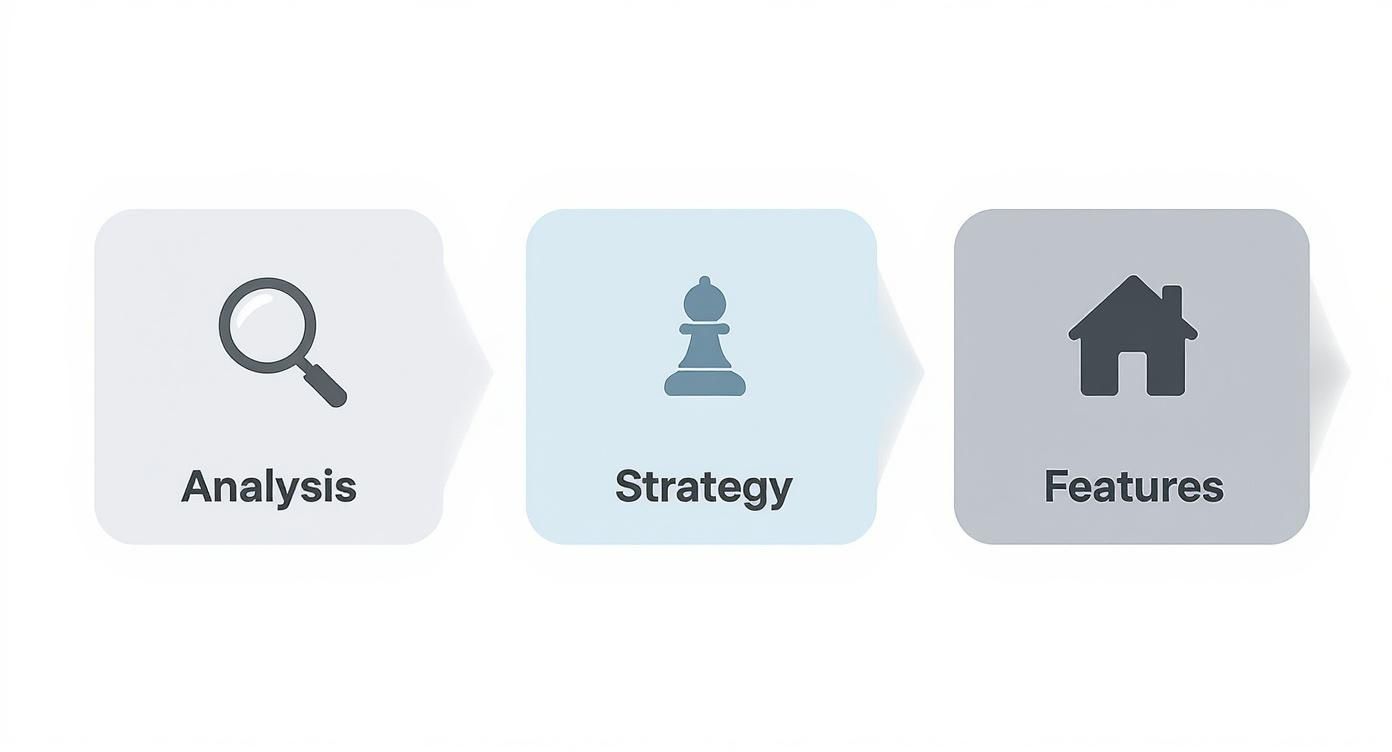
As this shows, a smart pricing strategy is a mix of hard data and an honest look at what makes your home unique.
Let’s break down what each type of listing tells you:
- Sold Listings: These are pure gold. They represent what buyers have actually paid for homes like yours recently. This is the historical proof of value.
- Active Listings: These homes are your direct competition. Looking at them tells you exactly what buyers are seeing right now and what price you need to beat to get their attention.
- Expired/Withdrawn Listings: These are cautionary tales. They represent the price ceiling—the point where the market said "no." Understanding why they didn't sell (it's almost always overpricing or poor condition) is a powerful lesson.
Making Dollar Adjustments for Differences
No two homes are ever truly identical, which is why you have to make financial adjustments to your comps. This is where experience really helps, but you can think of it as part art, part science. If a sold comp has a brand-new kitchen and yours is 15 years old, you have to subtract the value of that upgrade from its sale price to make it a fair comparison.
For example, say a nearly identical home sold for $450,000. But it had a professionally finished basement (which yours doesn't) that adds about $25,000 in value in your area. You would adjust that comp's price down to $425,000 to make it comparable to your property. On the flip side, if your home has a new roof and the comp doesn’t, you’d adjust its price upward.
The goal of a CMA isn't to find the highest possible number. It's to identify a tight, defensible price range that is backed by hard evidence. This data-driven approach builds your confidence and puts you in a strong negotiating position from day one.
In fact, studies consistently show that pricing a home within 5% of its true market value can drastically reduce how long it sits on the market. Price it more than 10% above, and you risk becoming invisible to qualified buyers. That's why sales from the last 3-6 months are the gold standard—markets shift quickly.
Understanding what's actually happening with home prices today can add another critical layer of context to your analysis.
Putting together a thorough CMA is detailed work, and having an objective, expert eye can make all the difference. If you need a hand gathering data or just making sense of the numbers, our team is ready. We offer next day appointments and have 7 day a week availability. Our team is always here for you via phone, text, email, and chat, so you can get professional guidance and fast results exactly when you need them.
Choosing Your Go-to-Market Pricing Strategy
Okay, you’ve done the heavy lifting and have a solid price range from your Comparative Market Analysis. Now comes the strategic part: picking the right number to hit the market with. This isn't just about plucking a figure out of thin air; it’s about positioning. Your list price sends a direct message to buyers from day one and sets the stage for everything that follows—showings, offers, and the final negotiation.
Think of it this way: are you aiming for a quick, straightforward sale? Or are you trying to spark a bidding war? Your answer will point you toward one of three classic approaches. The best choice really hinges on your local market’s temperature, how quickly you need to sell, and frankly, your stomach for a little bit of risk.
Pricing at Fair Market Value
This is the most common and often the safest bet. You simply price your home right in the sweet spot suggested by your CMA. It’s a transparent, no-nonsense strategy that signals to buyers that you’re serious and have done your research.
In a balanced market—where there isn't a crazy surplus of homes or a desperate shortage of them—this approach works beautifully. It attracts well-qualified buyers who are ready to make a fair offer, helping you secure a solid contract without a lot of drama.
Pricing Slightly Below Market Value
Here’s where things get interesting. In a hot seller's market with very little inventory, intentionally pricing your home a little under its perceived value can be a brilliant move. The goal isn’t to give your house away; it’s to create a feeding frenzy.
This tactic makes your listing look like the best deal on the block, which can trigger a flood of showings and multiple offers right out of the gate. When buyers have to compete, their fear of missing out often drives the price well above what you asked for. You can dive deeper into these proven strategies to bring in multiple buyers when selling your property.
Be warned, though: this strategy has a downside. If that bidding war never happens, you might find yourself cornered into accepting an offer at that lower list price.
Pricing Slightly Above Market Value
On the flip side, you could start at the top end of your CMA range or even a bit higher. This strategy is all about leaving yourself some wiggle room for negotiations. It can work for a truly one-of-a-kind property or in a market where there are very few homes for sale.
The obvious plus is that you can accept an offer that’s below your asking price and still walk away with your target number. The major risk? You could price yourself right out of the market from the start.
An overpriced home is often an invisible one. Buyers and their agents may skip your listing entirely, assuming you're unrealistic or unwilling to negotiate, which can lead to your property languishing on the market.
The Power of Psychological Pricing
Beyond the big-picture strategy, don’t forget the small details that make a big difference. Psychological pricing is a subtle but powerful tool that uses pricing to influence a buyer’s perception.
It’s about setting a price just below a round number. Why?
- A home listed for $499,900 instead of $500,000 just feels more affordable.
- More importantly, it shows up in more online searches. Your listing will appear for buyers searching "up to $500,000," but it will also catch those who set their maximum at $499,000.
This simple tweak can dramatically increase the initial traffic your listing gets, all without making a meaningful dent in your bottom line.
Deciding on the best path forward involves a careful read of the market and buyer psychology. We know it can be a lot to navigate. Our team has 7 day a week availability, with next day appointments ready to help you analyze your unique situation and craft the perfect pricing strategy for your goals. Our customer service is here for you 7 days a week via phone, text, email, and chat for the results you need.
Fine-Tuning Your Price: The Art Behind the Science
A solid comparative market analysis (CMA) gives you a fantastic starting point—a data-driven price range. But that’s just the beginning. Your home isn't a carbon copy of the one down the street, and this is where the real expertise comes in. We need to move beyond the raw numbers and start looking at the specific details that make your property unique.
Think of it this way: a CMA might tell you two three-bedroom homes in the same neighborhood are worth roughly the same. But what if one has a brand-new, gourmet kitchen and the other is rocking its original 1990s cabinetry? That difference is worth real money, and figuring out exactly how much is key to landing on the perfect list price.
Turning Upgrades and Condition into Dollars
The best way to value your home’s unique characteristics is to step into the shoes of a buyer and an appraiser. They have a keen eye for what truly adds value, and it’s not always what homeowners expect. Some renovations pack a much bigger punch than others.
Here’s where buyers focus their attention (and their money):
- Kitchens & Bathrooms: These are the showstoppers. A beautifully updated kitchen or a spa-like master bath can be a massive selling point and justify a higher price tag. An outdated one? That's an immediate mental deduction for most buyers.
- Major Systems: A new roof or a brand-new HVAC system isn't glamorous, but it screams "move-in ready." Buyers see this as thousands of dollars they won't have to spend, giving them the confidence to offer more.
- Curb Appeal & Outdoor Living: Never underestimate a first impression. A well-maintained lawn, a welcoming front porch, or a great deck for entertaining creates an emotional connection before buyers even step inside.
On the flip side, you have to be brutally honest about any drawbacks. That leaky faucet or the worn-out carpet in the den might seem minor, but buyers will often overestimate the cost and hassle of fixing them. If you don't address these issues beforehand, be prepared for lowball offers that more than account for the repair costs.
Timing is Everything: Riding the Market Waves
Your home’s physical state is only half the equation. When you sell can have a huge impact on your bottom line. The real estate market has its own seasons, and listing at the right moment can mean a faster sale for a higher price.
The spring market, which usually kicks off in March and runs through June, is historically the hottest time to sell. More buyers are out looking, and the fresh inventory creates a sense of urgency. Listing your home just before that rush can position you perfectly to capture that peak demand. In contrast, selling during the late fall or around the holidays often means fewer buyers and more competition from sellers who need to move, which can soften prices.
Beyond the season, you have to consider the broader economic climate. Is the market heating up, cooling down, or holding steady? Setting an ambitious price in a declining market is a recipe for sitting stale, while pricing too conservatively in a rising market means leaving money on the table.
Looking at the big picture shows just how much these trends matter. Between 2010 and 2024, residential property prices in many developed economies jumped by an average of 40-60%. In a typical, stable market, you might see prices shift 3-7% year-over-year. This is why we look beyond your street to understand the larger forces at play. You can dig into some of the data behind these global property price movements on BIS.org.
Nailing the value of a kitchen remodel or picking the perfect week to list isn't simple. It takes a deep, hands-on understanding of the market. This is where professional guidance makes all the difference. Our team is here to help you navigate these nuances with 7 day a week availability. We offer next day appointments for quick, practical advice and results. You can always reach our customer service 7 days a week by phone, text, email, and chat whenever a question comes up.
Boosting Perceived Value to Justify Your Price
Setting the right list price is the science, but selling your home is an art. Buyers rarely make decisions based on spreadsheets alone; they buy on emotion. This is where perceived value comes in—making your home feel like it's worth every penny from the moment a buyer sees that first photo online.
Think of it this way: your price is the logical argument, but your home's presentation is the emotional closing statement. You have to create a powerful first impression that sticks with buyers long after they've scrolled past a dozen other listings.

The Undeniable Power of Professional Visuals
Let's be blunt: blurry, dark smartphone photos will kill your price before a buyer even reads the description. Professional real estate photography isn't a luxury anymore; it's a non-negotiable part of the process.
Great photos do more than just show a room. They capture the way natural light fills the space, highlight the open flow of the floor plan, and create a mood. In a sea of online listings, stunning visuals are what stop the scroll. The national average for a standard real estate photoshoot is only around $230, a tiny investment for a massive return in buyer engagement.
To really make your listing pop, think beyond standard photos:
- Aerial Drone Photography: Nothing shows off a great lot, a beautiful view, or proximity to a park like a drone shot. It gives buyers a perspective they can't get from the street and immediately showcases the entire property.
- Matterport 3D Tours: These aren't just video slideshows. They are fully immersive walkthroughs that let buyers explore your home from their own living room. This is a game-changer for attracting out-of-town interest and pre-qualifying highly serious buyers.
Staging Your Home to Highlight Its Best Features
You live in your home, but you're selling a house. Staging is the art of turning your personal space into a product that appeals to the widest audience possible. It's about helping buyers envision their life there, not yours.
This can be as simple as decluttering and tucking away family photos, or it might mean bringing in a professional to furnish an empty space. The goal is always the same: create a clean, bright, and inviting environment that feels both aspirational and welcoming. Curious about the ROI? You can learn more about the benefits of home staging here.
A beautifully staged home doesn't just look better—it feels more valuable. It signals to buyers that the property is well-maintained and move-in ready, which is a powerful motivator that helps justify your asking price.
Crafting a Compelling Narrative
Once the photos have done their job, your property description needs to close the deal. Don't just list facts like "3 bed, 2 bath." Tell a story.
Instead of saying "updated kitchen," describe the "spacious quartz island perfect for morning coffee or homework sessions." Talk about the "backyard oasis, ideal for summer barbecues with friends." You're not just selling rooms; you're selling a lifestyle.
And don't forget to mention key upgrades. That new HVAC system or a recent roof replacement adds tangible value. High-impact features like solar panels can also be a major draw, so it's always smart to understand if are solar panels worth it for your property. This narrative approach turns features into benefits, creating an emotional hook that reinforces your price.
Trying to figure out which marketing moves will give you the best bang for your buck can feel overwhelming. That’s why we offer next day appointments to help you strategize and get the results you want. With 7 day a week availability and customer service support via phone, text, email, and chat, you can get the expert advice you need, when you need it, to maximize your home's value and secure a top-dollar sale.
Making Smart Price Adjustments After Listing
Think of your initial list price as your opening statement, not the final word. The real conversation begins once your home hits the market. What it "says" back in those first few weeks is everything.
Honestly, a home’s first 14 to 21 days online are make-or-break. If you're met with silence, the market is sending a clear signal: the price is off. The worst thing you can do is wait and hope. A proactive adjustment keeps your listing fresh and avoids the dreaded "stale" tag that makes buyers suspicious.
Reading the Early Market Signals
From day one, you need to be watching the data like a hawk. Three metrics will tell you the real story of how your price is landing with actual buyers.
This is your early warning system:
- Online Views & Saves: Are people even seeing your listing? If you have low online traffic, your price might be so high that you're not even appearing in the right search filters.
- Showing Requests: This is where the rubber meets the road. Getting tons of clicks but no one booking a tour means they like what they see online, but the price tag is scaring them away from taking the next step.
- Feedback from Showings: Listen carefully to what agents and their clients say after a visit. If you keep hearing things like, "Beautiful home, but it feels overpriced for the neighborhood," that's not an opinion—it's gold. It’s direct, unfiltered market feedback.
What if you're getting plenty of showings but zero offers? This is actually a good sign, believe it or not. It means buyers are genuinely interested, but the value they see in person doesn't quite line up with your price. Often, a small, strategic price tweak is all it takes to turn those tours into offers.
For a deeper dive, check out our guide on when to reduce your listing price.
Making a Strategic Price Reduction
When all signs point to a price change, you need to be decisive. A tiny, timid price drop of a few thousand dollars won't cut it—it looks desperate and rarely gets the job done.
You need to make a meaningful reduction that gets buyers' attention and shows you're serious about selling.
A recent U.S. housing market outlook from J.P. Morgan for 2025 highlights just how critical this balance is. In today's market, smart pricing has to walk a fine line between inventory levels and what buyers can actually afford. Their analysis confirms that a well-calibrated price is the key to attracting solid offers without leaving money on the table.
A strategic price cut isn't an admission of failure—it's a smart marketing move. It gets your property back in front of buyers and their agents through new MLS notifications, effectively relaunching your listing to a fresh audience.
Making these calls can feel overwhelming. That’s why our customer service team is on standby 7 days a week via phone, text, email, and chat. We can help you analyze the feedback, make sense of the data, and decide on the right next move. With next day appointments available, we’re here to provide the support and results you need to get your home sold.
Common Questions on Pricing Your Home for Sale
Even with the best data and a solid strategy, a few nagging questions always seem to surface. It's completely normal. Let's tackle some of the most common pricing concerns we hear from sellers just like you.
Should I "Pad" My Price to Leave Room for Negotiation?
It’s an old-school tactic that makes sense on the surface: price it high, so you have wiggle room to come down. But in today's market, this approach can seriously backfire.
An inflated price doesn't just leave room for negotiation; it often leaves you with no one to negotiate with. Overpriced homes tend to scare off qualified buyers who might not even bother to look, assuming you’re not a serious seller. A much smarter strategy is to price your home right at its fair market value. This attracts a wider pool of serious buyers from day one and can even spark a competitive bidding situation, which is a far better position to be in.
What if an Online Estimator Says My House is Worth More?
Those instant online valuation tools are interesting, for sure. But they should be treated as a ballpark figure at best, not a true valuation. They're essentially algorithms crunching public data—tax records, recent sales in a broad area—and they can't see the full picture.
These tools have no idea you just spent $50,000 on a kitchen remodel, that your neighbor's "comp" had a leaky roof, or that your home has a one-of-a-kind view. They are simply not a substitute for a detailed Comparative Market Analysis (CMA) prepared by someone who understands the nuances of our local market.
Real-world data is king. Your most accurate price will always come from a careful analysis of what actual buyers have been willing to pay for homes just like yours, in your specific neighborhood, in the last few months.
Landing on that perfect list price can feel like a heavy decision, but you don't have to carry that weight alone. Getting an expert opinion can bring the clarity and confidence you need to move forward. Our team is here to help you make sense of the data and answer any questions you have.
We offer next day appointments and deliver fast results. Plus, our customer service team is on standby 7 days a week via phone, text, email, and chat to support you every step of the way with our 7 day a week availability.
Ready to get a clear, data-backed price for your home? The experts at Pinnacle Real Estate Marketing are available seven days a week to help you showcase your property's true value. Book your next-day appointment online today!


